


Popular Ways to Shop


Learn more about Art Deco Tiles
Your Guide to Art Deco Tile
Art Deco is a design movement from the 1920s and 1930s built on bold geometry, symmetry, and decorative richness. In tile, that means strong geometric patterns, high-contrast color combinations, metallic finishes, and shapes like hexagons, octagons, chevrons, and diamonds. The style has a vintage character that is hard to replicate with any other approach.
Art Deco tile is pattern-forward and meant to be noticed. Where contemporary tiles minimize visual detail and modern tiles favor plain surfaces, Art Deco tile is the focal point of the room. It works best when the surrounding space is kept simple so the pattern can read clearly. The style is related to but distinct from Art Nouveau tile, which favors organic curves and natural motifs over the hard geometry of Art Deco.
Art Deco Floor Tile and Wall Tile
Floor Tile
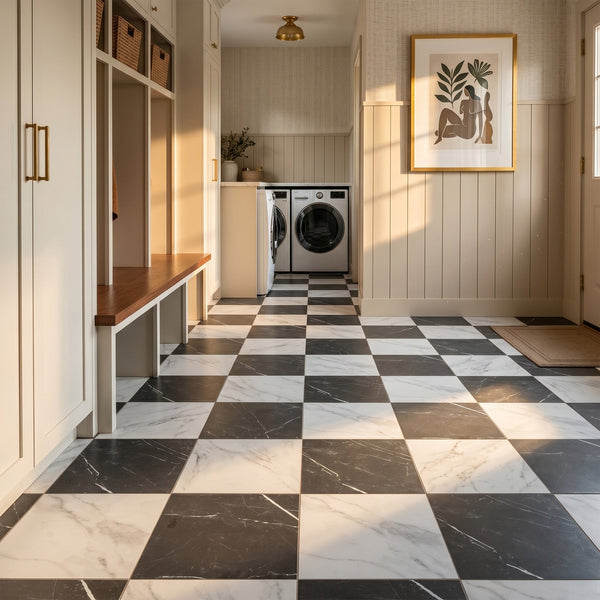
The classic Art Deco floor tile is a black and white geometric mosaic: octagon and dot, hexagon, or basketweave in polished marble or ceramic. These patterns were standard in the 1920s and still read as period-correct in bathrooms, entryways, and kitchens. The contrast between light and dark tile creates the geometric pattern, so grout color matters. Use white grout with white tile and dark grout with dark tile to keep the geometry sharp.
For a larger-format Art Deco flooring option, a 12x12 porcelain tile with an encaustic or decorative pattern in a symmetrical layout also works well. The key is that the pattern reads as intentional and geometric rather than organic. Browse floor tiles to see the full range of formats and patterns.
Wall Tile
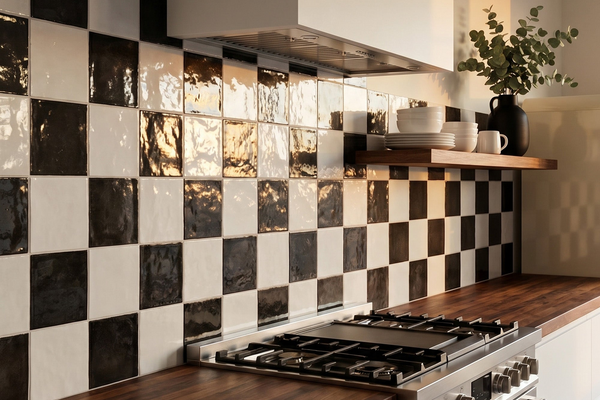
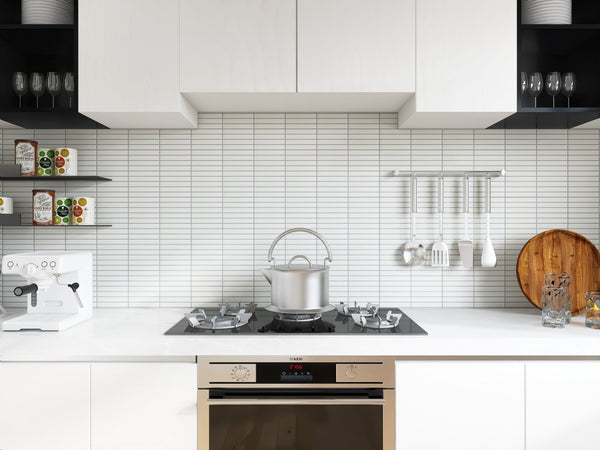
On wall tiles, Art Deco favors vertical formats and metallic or high-gloss finishes. A slim ceramic tile in white with a crackled glaze, stacked vertically, references the period without being heavy. Marble mosaic panels in a herringbone or chevron layout on a bathroom feature wall are another strong direction. Glass and metal accent tiles in gold or brass tones add the decorative richness the style is known for.
Art Deco Tile by Room
Bathroom
The bathroom is the most natural space for Art Deco tile. A black and white octagon and dot mosaic floor with white subway tile walls is the most historically accurate version of the style. For a more updated take, use a polished marble hexagon floor with a large-format white bathroom tile on the walls and brass fixtures. In both cases, the contrast between the patterned floor and the plain walls gives the pattern room to read clearly.
Backsplash
A backsplash is a contained area where Art Deco tile can make a strong statement without taking over the room. A chevron or herringbone marble mosaic behind a kitchen sink, or a decorative ceramic panel in a geometric repeat pattern behind a range, both work well. Keep the surrounding cabinetry and countertop simple so the tile pattern stays the focus.
Entryway
An entryway floor is a traditional Art Deco application. The floor is the first surface you see when you walk in, and it covers a defined, bounded area that suits a bold pattern. A classic octagon and dot pattern in black and white marble or ceramic is durable, easy to clean, and historically accurate to the period.
How to Choose Art Deco Tile
Keep the surrounding space simple. Art Deco tile is pattern-forward. If the floors, walls, and fixtures all compete for attention, the result feels busy rather than bold. Choose one surface for the pattern and keep everything else neutral.
Use symmetry in your layout. Art Deco design is built on geometric order. Before installation, dry-lay the tile and center the pattern in the room so it reads as intentional from every angle. A centered layout also avoids awkward partial tiles at the edges.
Match your grout to the pattern's geometry. In a two-color mosaic, grout color affects how sharp the pattern reads. Grout close to the lighter tile will soften the contrast; grout close to the darker tile will sharpen it. Decide which effect you want before you order.
Consider scale relative to the room. A small 1x2 mosaic pattern can disappear in a large room. A larger geometric format like a 6x6 or 8x8 encaustic tile holds up better at scale. Measure the room and view the pattern from a distance before committing.
Order samples before you commit. Geometric patterns in marble vary between tiles because the veining is different on every piece. A physical sample shows you how the pattern reads across multiple tiles together, and how the material looks in your space under your lighting. Order samples before ordering full quantities.
-
 Concrete Tiles
 -
 Decorative Tiles
 -
 Zellige Tiles
 -
 Modern Tiles
 -
 Contemporary Tiles
 -
 Traditional Tiles
 -
 Rustic Tiles
 -
 Farmhouse Tiles
 -
 Industrial Tiles
 -
 Mediterranean Tiles
 -
 Mid-Century Modern Tiles
 -
 Bohemian Tiles
 -
 Coastal Tiles
 -
 Scandinavian Tiles
 -
 Eclectic Tiles
 -
 Minimalist Tiles
 -
 Transitional Tiles
 -
 Encaustic Tiles


