







Popular Ways to Shop


5 Samples for $14.99
Five sample swatches of any tile for only $14.99. Learn more.
Tile Mart Trade Program
Member-only perks for industry professionals. Apply now.
Stress-Free Shipping
Flat-rate pricing with curbside and liftgate included. Learn more.
5% Off Your First Order
5% off your first purchase when you subscribe to our email list. Join now
Learn more about Tile Edge Trim & Borders
Your Guide to Tile Edge Trim
Tile edge trim is a finishing piece that covers and protects the exposed edge of a tile installation. You'll also see it called tile trim, finishing trim, or tile edging, all referring to the same category of piece. Instead of leaving a raw, unglazed edge exposed at a wall opening, countertop, or floor-to-wall transition, you cap it with a trim piece made to match or coordinate with the field tile.
Trim is not a tile style. It's a functional category that exists alongside every style, room, and material at Tile Mart. A bathroom finished in subway tile and a fireplace finished in marble both need trim at their exposed edges, just in different profiles and materials.
Types of Tile Edge Trim
Bullnose is the most common profile. It has one rounded edge built into the tile itself, so it caps an exposed edge with a smooth, finished curve instead of a sharp corner. It's a frequent choice at the top of a tiled wainscot or around a window opening.
Pencil liner, sometimes called pencil trim or chair rail liner, is a narrow, rounded strip closer in size to an actual pencil. It works as a decorative accent border rather than a structural edge cap, often run as a thin band between a field tile and an accent tile.
Cove base has a concave curve at the bottom edge, built specifically for the spot where a tiled wall meets the floor. The curve keeps water and debris from collecting in a sharp interior corner, which is why it shows up so often in bathrooms and commercial kitchens.
Tile corner trim caps an outside corner where two tiled surfaces meet at 90 degrees, the kind of edge you'd otherwise have to miter by hand. Tile Mart carries tile trim profiles such as bullnose, pencil liner, cove base, corner trim, and stair coping in select ceramic, porcelain, marble, travertine, quarry, and slate options.
Tile Edge Trim by Room
Bathrooms and showers are where trim does the most work. At the bathroom floor-to-wall transition, cove base keeps water and debris from collecting in a sharp interior corner, the spot that's hardest to keep clean otherwise. Along the top edge of a tiled shower wainscot, bullnose caps the exposed edge with a finished curve instead of a sharp cut. Both spots take constant water exposure, so a trim piece in the same glaze as the field tile keeps the finished look consistent while helping cover and protect a vulnerable exposed edge.
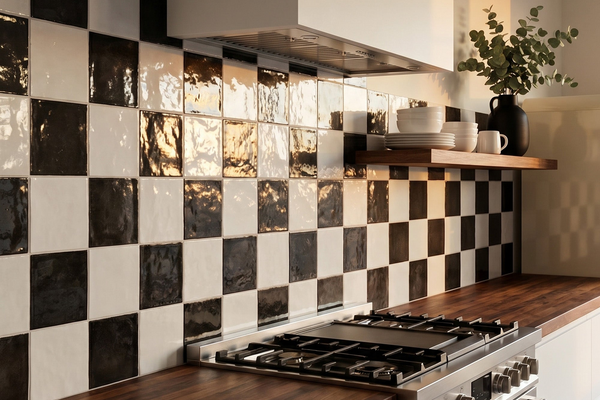
In a kitchen, pencil liner is the usual choice for a backsplash, run as a thin accent line between the field tile and the counter or as a border around an accent panel. Corner trim handles the outside corners where a backsplash wraps around a wall edge or appliance gap.
Trim shows up less often outside wet areas, but a fireplace surround or a pool deck still needs an edge cap. For either, pick a dense porcelain or properly sealed natural stone trim. For fireplaces, pools, and exterior areas, choose trim rated for that application. Porcelain is often a durable option, while natural stone should be properly sealed and maintained if used around water.
How to Choose Tile Edge Trim
Match the trim thickness to your tile thickness. A trim piece thinner than your field tile leaves a lip at the seam that catches a cloth, a bare foot, or a mop. Check the listed thickness of both before you order, especially when mixing trim material with field tile from different lines.
Match the finish, not just the color. A glossy bullnose next to a matte field tile will catch light differently even if the color is identical, and the mismatch is more obvious in person than in a photo. Order a sample of the trim alongside your field tile sample before committing.
Pick a material built for the location. Porcelain trim is often a strong choice for wet areas and many outdoor applications, but always check the product’s approved use before installing it outside. Glazed ceramic trim works well for many interior wet walls, while natural stone trim usually needs sealing. Marble, travertine, and slate trim are porous and need a penetrating sealer, the same as the field tile they're paired with, or they'll stain and absorb water at the edge first.
Decide between a trim piece and a mitered edge. A mitered corner, where the field tile itself is cut and joined at an angle, gives a seamless look with no visible trim piece, but it costs more in labor and only works cleanly with certain tile thicknesses. A trim piece is faster to install and more forgiving on uneven cuts.