







Education

Quick Summary:
Choose large format tile (edges over 15") for open floors and full-height walls where fewer grout lines create a seamless, low-maintenance look. Choose small format tile for sloped shower pans, curved surfaces, cut-heavy layouts, or subfloors that can't meet strict flatness tolerances. Where the tile goes determines the size, not which option is better.
You've settled on your material. Now you're staring at a choice between a 24x48 large format tile and a 2x2 mosaic sheet, and the two feel like completely different projects.
Here's how the decision breaks down surface by surface, and what each choice costs you after the installer leaves.
Should You Use Large Format or Small Format Tile?
Large format tile means any tile with an edge over 15 inches, per the TCNA Handbook. It's the better default for open floors and full-height walls, where fewer grout joints read as one continuous surface. Small format tile is the right choice for shower pans, curved surfaces, cut-heavy rooms, and substrates that can't be made flat. Where the tile goes decides, not which size is better, when evaluating large format vs small format tile.

What Counts as Large Format Tile?
Any tile with a single edge longer than 15 inches. That's the TCNA threshold, and it matters because it's where installation requirements change, not just how the floor looks. A 12x24 is standard format. An 18x18 is large format. Slabs and planks sit well past the line.

Large Format vs. Small Format Tile: Key Differences
| Large Format | Small Format | |
|---|---|---|
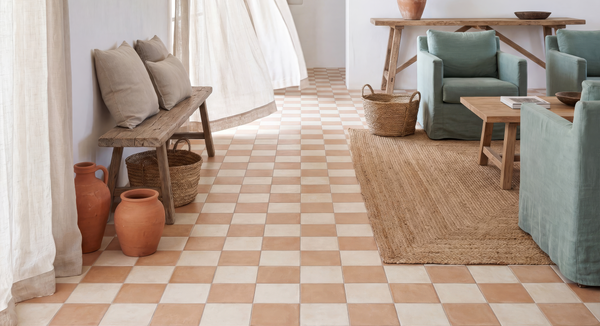
| Grout Lines | Few. The surface reads as continuous | Many. The grid is part of the design |
| Substrate Prep | Flatness tolerance is tight; leveling is often required | Tolerant of minor variation |
| Wet Traction | Fewer joint edges underfoot | More joint edges, but finish and material do more of the work |
| Cut Waste | High in cut-heavy rooms. One cut can consume most of a tile | Low. A cut costs you inches |
| Repair | Replacing one tile disturbs a large area | Replace a few pieces or a section of a mesh sheet |
| Upkeep | Less grout to clean and seal | More grout to clean, and grout color carries more of the look |
When to Choose Large Format Tile
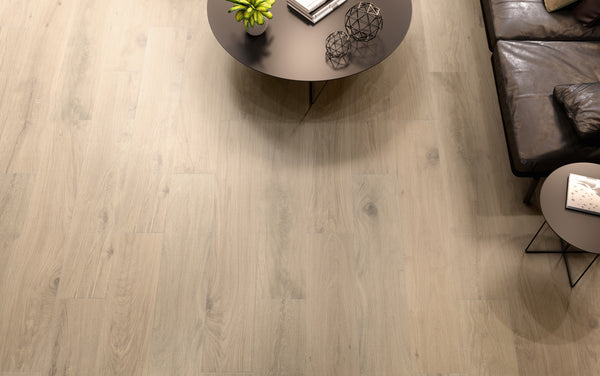
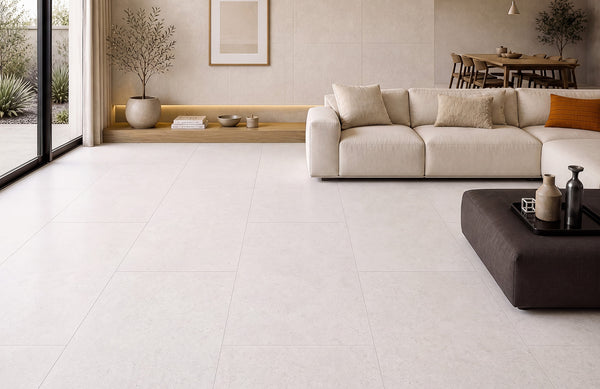
Open floors and full-height walls. On a long, uninterrupted floor, fewer joints mean less visual noise. On a shower wall or a fireplace surround, a slab can cover the height with one or two joints instead of a dozen.
Less grout is also less upkeep. Grout shows wear before the tile does, and fewer joints mean less surface to scrub and seal.

Installation Requirements for Large Format Tile
Flatness, first. ANSI A108.02 calls for substrate variation of no more than 1/8 inch in 10 feet and no more than 1/16 inch in 2 feet for large format tile. That's tighter than the tolerance customary for standard format. Miss it, and you get lippage: a height difference between the edges of two adjacent tiles, which you feel underfoot and see under raking light. In the debate between large format tile vs small format tile, small format hides what large format reveals.
Large format also typically calls for two things. Medium-bed mortar is a thicker-bodied mortar made to support a large tile at a deeper bed without slumping. Back-buttering means the installer trowels mortar onto the back of the tile and the substrate. Both are common requirements, not universal ones. Check the install sheet for the tile you're buying.
Layout has limits, too. If you want a running bond, the offset is generally capped at around one-third of the tile's length once an edge passes 18 inches. A half-offset brick set often isn't an option in plank formats.
When is Small Format the Right Choice?
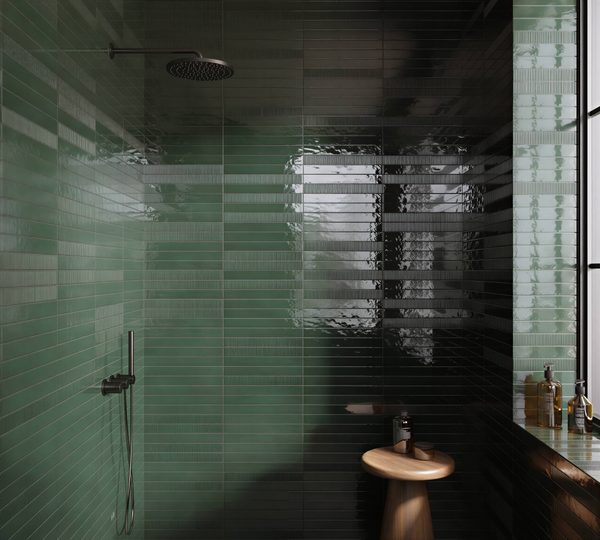
- A shower pan slopes toward the drain in more than one plane. Mesh-mounted mosaic conforms to that slope, and around benches, curbs, and niches. A large tile can't sit in two planes without cuts, and forcing it produces lippage right where water needs to move.
- More grout joints mean more edges underfoot. That helps, but it isn't the whole picture. DCOF (dynamic coefficient of friction, the standard measure of wet traction) is driven mostly by finish and material. Pick for traction first, then let the joint count add to it. Our bathroom tile guide covers how to read a slip rating.
- Small baths and rooms broken up by fixtures are decided by waste. Every cut in a 24x48-inch tile sacrifices most of a tile. The same cut in a 4x4 sacrifices almost nothing. Plan the usual 10–15% overage either way, because waste is layout-driven, not size-driven. Our layout and waste guide shows how a pattern changes that number. In a kitchen, start with what size tile suits a kitchen floor.
- Older wood subfloors rarely meet the large format flatness tolerance without self-leveling the room. If leveling isn't in the budget, small format is the cheaper, honest answer, not a compromise.
Is Large Format Tile More Water-Resistant Than Small Format?
No. Water absorption is a property of the tile body and has nothing to do with how many grout joints are in the floor. A porcelain tile absorbs the same amount of water at 24x48 as it does at 2x2. What changes with joint count are grout maintenance and traction.
How to Test Large and Small Format Tile Samples in Your Room
Screens don't reproduce tile color, and they can't show texture. Order samples of the finishes you're weighing and look at them in the room, under the light that the room gets.
If the series has meaningful shade variation, dry-lay before setting, and blend tiles from multiple boxes so the variation spreads across the surface rather than pooling in one corner.

Pros and Cons: Large Format vs. Small Format Tile
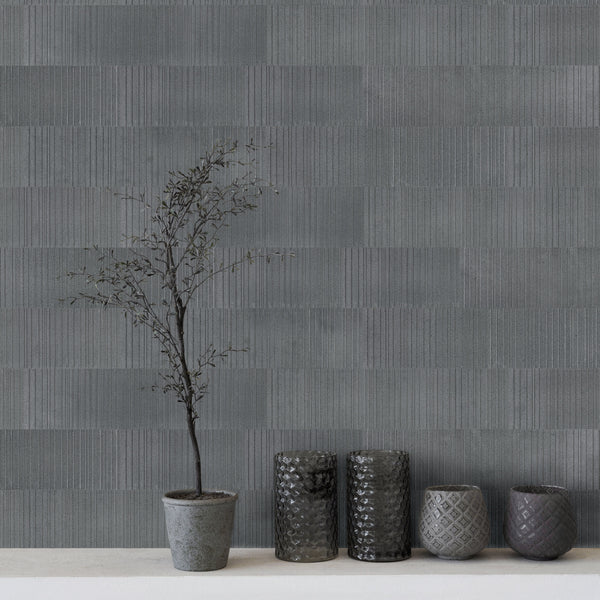
More grout. More joints mean more cleaning, more sealing where the product calls for it, and a grout color that carries real weight. At small format, grout is a design element, not filler. Choose it deliberately and see how grout color changes a tile's look first.
Go large format, and you're accepting the prep instead. The flatness tolerance is a real cost, paid in self-leveler or in a longer install. Neither format is free.
Frequently Asked Questions
Is large format tile cheaper or more expensive to install than small format?
Large format tile often costs more to install per square foot than standard or small format tile. While large tiles cover more surface area per piece, they require precise subfloor leveling (ANSI A108.02 compliance), specialized tools, medium-bed mortars, and two-person handling for larger slabs. Small format tile requires less subfloor preparation but requires more labor time for grouting and mosaic alignment.
Is small format tile better for small bathrooms?
Not always. While small format tile or mosaics conform well to tight cuts and sloped shower floors, using small format tile across a main bathroom floor creates a high density of grout lines that can make a small room feel visually cluttered. Using large format tile with minimal grout joints can actually make a small bathroom feel larger and more open, provided the subfloor is flat enough.
Does large format tile require special mortar?
Yes. Large format tile (any tile with an edge over 15 inches) requires medium-bed mortar (now classified under ANSI A118.4/A118.15 as Large and Heavy Tile mortar). Standard thin-set mortar shrinks as it cures, which can pull heavy, large tiles out of alignment or create voids underneath. Large format mortar holds its body, supports the tile’s weight, and prevents slumping.
Do you have to seal grout lines on small format tile?
Yes, cementitious grout should always be sealed—especially on small format installations where grout makes up a significantly higher percentage of the surface area. Because small format floors feature a high volume of grout joints, keeping them sealed protects against moisture, dirt, and mold buildup, making long-term cleaning much easier.
Large Format vs. Small Format Tile: The Bottom Line
Key Takeaway: Make your large format vs small format tile decision based on surface type and structural requirements, not just on visual preference.
Before placing your final order, follow these practical steps:
- Order tile samples: Select at least one large format option and one small format option for the same space, then lay them out in the room.
- Evaluate under actual lighting: Examine your samples in the exact room lighting, as screens cannot reproduce true surface texture or depth.
- Dry-lay and blend: If the series has meaningful shade variation, dry-lay tiles from multiple boxes prior to setting so the variation spreads naturally.
- Inspect your subfloor: Confirm whether it meets the strict flatness tolerances required for large format tile, or build self-leveling prep into your budget.
If you're unsure whether your subfloor can support large format tile or how a layout will work around your fixtures, talk to support before you order.
Our 365-day return policy is designed to support your planning process, allowing you to order samples and dry-lay your materials with the flexibility you need.