




Education

Quick Summary: Learning how to seal Saltillo tile before installation is critical because raw, unglazed terracotta is highly porous and will permanently absorb stains from grout, thinset, and moisture. Before starting your project, confirm whether your tile is raw clay or factory-sealed. Raw Saltillo must receive a penetrating sealer before grouting to act as a barrier against pigment absorption. Once set and grouted, topcoat sealers can be applied to achieve a satin or glossy finish. Because sealers alter the clay's color tone, always test your chosen sealer on a physical sample tile under your home's lighting before coating your entire floor.
Your Saltillo is stacked in the garage, and the install starts in a few days. Before anything gets set or grouted, you need to know one thing: whether the tile in those boxes is sealed or raw.
If it's raw, learning how to seal Saltillo tile isn't a maintenance step you can put off. It's the first step of the installation. Saltillo is handmade, unglazed clay, low-fired, and porous all the way through, and cement grout will soak straight into it. Sealing after that happens doesn't clean the stain. It locks it in.
This guide covers the sequence, two sealer types, below-grade risk, and cost of upkeep.
How Do You Seal Saltillo Tile?
- Confirm Status: Verify if your tile is pre-sealed or raw. Raw Saltillo is porous and must be sealed before applying grout or thinset.
- Prep: Ensure tile is clean and 100% dry.
- Test: Apply your chosen sealer to a spare tile to verify the color change.
- Seal: Apply penetrating sealer to the raw clay until saturated; wipe away excess.
- Install: Grout and let cure; apply topcoats last for sheen.
Is Your Saltillo Sold Sealed Or Unsealed?
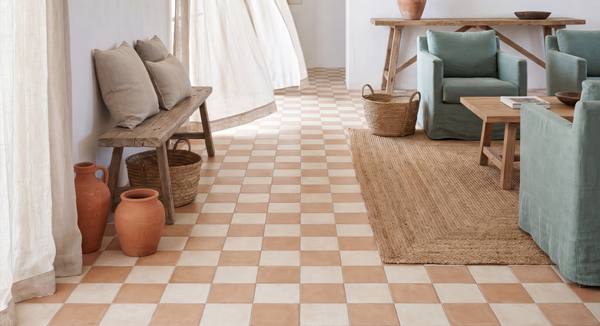
Plenty of Saltillo on the market ships pre-sealed. A pre-sealed tile still looks matte and thirsty, but you can't tell from a photo or a quick look.
If your tile is pre-sealed, you're not sealing raw clay. You're deciding whether to add topcoats after installation, using a product that the tile's existing sealer will accept. If your tile is raw, everything below applies in order.
Ask support to confirm the status of the specific SKU you're ordering. Ordering before you know which one you have is one of the more expensive mistakes people make when buying tile.
Important: If you are purchasing Terracotta Italian Saltillo, verify the material type with support. If your product is a porcelain Saltillo-look, it does not require sealing. Sealing porcelain will cause a hazy, sticky surface that is difficult to fix. Apply these instructions only to genuine, unsealed fired-clay terracotta.
Do You Seal Saltillo Before Grouting?
Yes, and there's no version of this job where you skip it.
Cement grout is pigment suspended in water. Raw Saltillo pulls that water in, and the pigment travels with it below the surface, where no cleaner reaches it. You don't get a hazy tile you can scrub. You get a permanently discolored one. Thinset, the cement-based mortar that bonds tile to the subfloor, does the same thing wherever it squeezes up between tiles. So does a coffee cup knocked over during the install.
Sealing after grouting can't reverse it. The sealer goes over the stain and keeps it there.
Should You Seal Loose Tile Or Set It First?
Published instructions disagree here, and the disagreement is real rather than sloppy. Both approaches work. They protect against different risks, so settle this before you open a pail of anything.
Sealing every tile before it's set means the clay is protected before any mortar or grout is in the room. Setting first, then sealing before you grout, moves faster on a large floor and lets that first coat double as grout release. It also leaves finished, unsealed clay sitting exposed while you work.
| Seal the loose tile first | Set first, seal before grouting | |
|---|---|---|
| Best for | Smaller floors, DIY pace, one-room jobs | Larger floors, crews working in stages |
| Main advantage | Clay is never exposed to mortar or grout | Faster, and the pre-seal coat also acts as a grout release |
| Main risk | Handling and setting already-sealed tile | Spills, dust, and foot traffic on raw clay before sealing |
| Requires | Space to lay out and coat tile | Protecting the field until the sealer goes on |
Pick by exposure, not by square footage. If the raw tile will sit in a working room overnight, near a doorway, or under anyone's boots, sealing Saltillo tile before installation is the safer call. Call support if you're weighing the two for a large floor. The Ceramic Tile Education Foundation (CTEF) is also a good resource for questions about installation sequence.
How To Seal Saltillo Tile: What's The Sequence?
This is the pre-seal path, written for raw tile. If you're setting first, the note under each step tells you which shifts.
- Confirm sealed or unsealed. Everything downstream depends on it.
- Clean and fully dry the tile. Dust in the pores or moisture in the clay both stop the sealer from penetrating. Dry means dry through, not dry to the touch.
- Test on one spare tile. Sealer changes Saltillo's color, usually toward a deeper, richer tone. Find that out on a tile you're not installing. Order a sample and test your sealer on it before the pallet arrives, so the color you're committing to isn't a surprise on the floor.
- Apply penetrating sealer to the raw clay. Expect multiple coats, because the clay drinks the first one. You've reached saturation when the sealer stops absorbing and starts to bead on the surface. Wipe the beading off, since the sealer left standing dries as a blotch. That first coat also works as grout release, meaning it keeps grout from bonding to the tile face, so haze wipes away instead of soaking in. Setting first? This coat goes on after the tile is set and before you grout.
- Set the tile with thinset. Soft clay pulls water out of the mortar, so it grabs faster than you'll expect. Work in smaller areas than you're used to. Flatten the substrate first, to the tolerances in the TCNA Handbook, because Saltillo's own thickness varies tile to tile, and a wavy subfloor turns that into lippage, the uneven edges you can feel underfoot.
- Grout in small sections and clean as you go. Two square feet at a time. Porosity means haze sets fast, and once it's in the clay, it isn't coming out. If you're still choosing a color, grout color changes terracotta more than you'd expect.
- Let the grout cure, then apply finish coats. Follow the cure window on the sealer's technical data sheet before topcoating. Guessing here traps moisture under the film.
Which Saltillo Tile Sealer Do You Need, Penetrating Or Topical?
Most traditional installations use both, because they do different jobs.
| Penetrating (impregnating) | Topical (film-forming) | |
|---|---|---|
| How it works | Soaks into the clay, protects from within | Builds a layer on the surface |
| Look | Natural, matte | Satin to gloss, the sheen most people picture |
| Wear pattern | No film to wear through, though the sealer does wear out of the clay | Wears in traffic paths |
| Renewal | Reapply | Strip and recoat |
| Below grade | Breathable, the safer choice | Can trap slab moisture |
If you want the low sheen Saltillo is known for, you need a film. Accept that the film is a maintenance item.
One note on older tutorials: some still call for Rexcel, an oil-based product no longer widely available. If a set of instructions names it, the timings in the rest of those instructions may not match anything you can buy today. Work from the label on the sealer, actually in your hand.

What If The Floor Is Below Grade Or On A Slab?
Mineral salts move to the surface with moisture and bloom as a white haze. That's efflorescence, and it shows up on slabs, in basements, and anywhere without an effective vapor barrier. A film-forming sealer over a slab that's still releasing moisture can trap that moisture and cause clouding or blistering.
Efflorescence has to be gone, and the tile has to be fully dry before you seal. Breathable penetrating sealers are the safer choice for below-grade applications.
Whether your slab is dry enough isn't something an article can tell you. Call support with the details of your subfloor before you commit to a film finish.
Is Saltillo More Work Than Porcelain?
Yes. Considerably. Porcelain is fired so densely that it needs no sealing, and on a porcelain floor, the grout joints are the only things asking for routine attention. Saltillo asks for a sealing program at install and a recoat schedule for the life of the floor.
That's the trade for the color, the softness, and the fact that no two tiles match. If it sounds like more than you want, terracotta-look porcelain gives you the palette without the program. Our terracotta guide covers where each one makes sense.

Are The Chips, Nodules, And Size Differences Defects?
No. Saltillo is formed and dried by hand, so you get irregular edges, small chips, lime nodules, thickness variations, and a wide range of colors across a single order. That's the material, not a quality problem. Shade variation ratings explain how much difference to expect before you open a box, and a sample tells you what the spread looks like in your own light.
Order enough for cuts and for the tiles you'll set aside.
Which Sealer Are You Using, And When Does It Go On?
That's the decision left, and it's two decisions in one. Choose the sealer first, then read its technical data sheet and let the dry and cure windows on that label set your schedule, not the other way around. If the label and this article ever disagree, the label wins.
One more constraint before you order: Saltillo isn't frost-resistant. Don't specify it for patios, steps, or any exterior surface in a freeze-thaw climate without written confirmation from the manufacturer's technical information for that specific product.
Order a sample and test your sealer on it first. This is the only way to preview the color change. Before placing your order, contact live support to confirm whether your specific SKU ships sealed or unsealed, and discuss below-grade moisture concerns. Our 365-day return period offers the planning flexibility you need for a successful install. Check the sealer manufacturer’s technical data sheet for product-specific dry and cure windows, and prioritize those over general advice.

Frequently Asked Questions
Can you seal Saltillo tile after installation?
You can apply topical finish coats after installation, and pre-sealed Saltillo is finished this way by design. However, if your tile is raw clay, you cannot skip sealing before grouting and try to fix it later. Applying a sealer over grout-stained clay will permanently lock the stain into the tile.
How often does Saltillo tile need to be resealed?
Resealing intervals depend on foot traffic, exposure to moisture, and the type of sealer used. Penetrating sealers generally last several years, while topical film finishes in high-traffic kitchens or entryways require reapplication sooner. When a topical finish begins to look dull or flat in main walkways, it is time to reapply.
Should I use a penetrating sealer or a topical sealer on Saltillo tile?
Most traditional Saltillo installations use both. A penetrating (impregnating) sealer soaks deep into the porous clay to protect against stains from within while keeping a natural, matte look. A topical (film-forming) sealer sits on top of the tile, providing surface gloss and sheen. For below-grade installations or concrete slabs prone to moisture, breathable penetrating sealers alone are the safer choice.
Is Saltillo tile suitable for outdoor installation?
Saltillo is not frost-resistant because its porous clay body absorbs water, which can cause it to crack during freeze-thaw cycles. Do not install Saltillo on outdoor patios, walkways, or steps in climates that experience freezing temperatures without written confirmation from the manufacturer's technical specifications.
Confirm Your Finish Before You Install
Because sealer permanently deepens the color of raw terracotta, testing your sealer on a sample tile is the only way to preview the exact tone and sheen before installation day.
Order a physical sample to test your sealer, or contact our support team to confirm whether your Saltillo SKU ships raw or pre-sealed.