


Popular Ways to Shop


Learn more about Minimalist Tiles
Your Guide to Minimalist Tiles
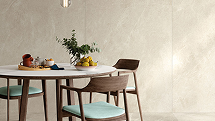
Minimalist tiles are defined by restraint. Clean lines, neutral tones, no ornamentation, and a deliberate reduction of visual noise. The goal is a surface that recedes into the room rather than competing with it. Let the architecture, the light, and a few well-chosen objects carry the space. Colors stay within a tight range: white, warm white, soft gray, greige, warm black, and muted earth tones.
The style is closely related to modern tiles and contemporary tiles, but more committed to simplicity than either. Modern can handle bold geometry and strong contrast. Contemporary moves with trends. Minimalist is a stricter edit: fewer elements, less variation, and a surface that holds together quietly at scale.
Minimalist Floor Tile
The most effective minimalist floor tile is large format. Bigger tiles mean fewer grout lines, which means less visual interruption across the floor. In a bathroom or open-plan kitchen, that continuity makes the room feel larger and calmer than a standard small-format grid.
Concrete-look tile is the quintessential minimalist floor material. It brings subtle texture and tonal variation without pattern. Warm grays, cool grays, off-whites, and near-blacks all work. The key is matching the grout closely to the tile color. Same-tone grout removes the grid from view and the whole floor looks like one surface. Large format stone-look tiles in a similar palette achieve the same effect with a softer, more organic feel.
Black tile is a strong minimalist floor choice, particularly in bathrooms and kitchens. A matte black porcelain with dark grout is monochromatic, sharp, and easy to maintain.
Minimalist Wall Tile
On walls, the layout matters as much as the tile itself. Tall, narrow tiles stacked in a straight vertical joint look cleaner than a traditional brick offset. Running them all the way up the wall creates height and rhythm without introducing pattern.
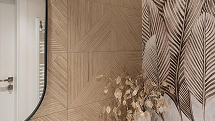
Fluted tiles are a strong minimalist wall choice. The vertical channel relief adds tactile depth without adding color or print. It is texture as the only decorative element. In a shower niche, above a vanity, or as a full feature wall, fluted tile brings dimension to a plain surface while still feeling calm and intentional.
Minimalist Tile by Room
Bathroom
For a minimalist bathroom, choose one tile and use it consistently across the floor and walls in the same or very similar tone. A large format matte porcelain in warm gray or off-white on both surfaces, with matching grout, creates a spa-like calm. The fewer the transitions, the more resolved the space feels. This approach also makes small bathrooms feel significantly larger. Unbroken surfaces look more spacious than tiled grids.
If you want a second material, introduce it in one place only. A fluted tile on a single accent wall, or a different finish on the floor alone, is enough contrast.
Kitchen
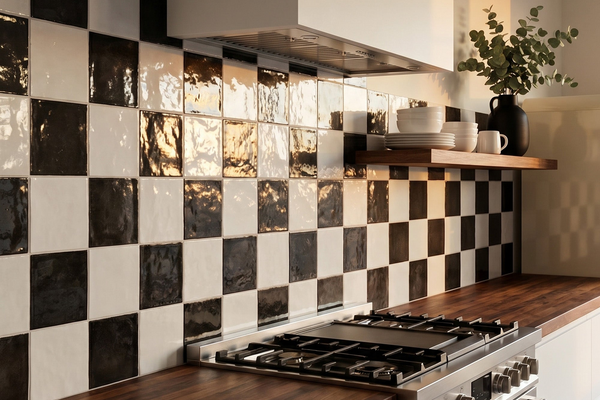
For a minimalist kitchen, keep the backsplash as simple as the floor. A large format porcelain slab behind the countertop in the same tone as the cabinetry makes the backsplash disappear as a separate design element. If you prefer a tiled kitchen backsplash, tall narrow tiles in a straight stack in a neutral tone keep the space unified. Avoid grout colors that contrast sharply with the tile. They add a grid that draws the eye away from everything else.
Shower
A minimalist shower works best as a single-material enclosure. Large format porcelain on three walls with a matching or close tile on the floor removes every unnecessary seam. If you need a niche, tile it flush in the same material so it disappears into the wall rather than becoming a detail.
How to Choose Minimalist Tile
Match your grout to your tile. Contrasting grout draws a grid across every surface. Choose a grout that matches the tile in tone and the floor or wall looks like one continuous plane instead of a pattern.
Go larger than you think you need. Larger tiles have fewer joints and less visual interruption. The same color in a bigger format will look noticeably calmer. If the space can handle it, go larger.
Matte over polished on floors. A polished floor shows every footprint and water mark. Matte and honed surfaces are more consistent over time and more forgiving in daily use.
Commit to a palette. Minimalist spaces work because the decisions are few and consistent. Choose one primary tile, one grout color, and one finish. A second material should be a deliberate accent, not a mix.
Use texture instead of pattern. If a completely flat surface feels too cold, fluted or relief tiles add interest without adding decoration. The texture shifts with the light rather than sitting on the surface as a fixed design.
-
 Concrete Tiles
 -
 Decorative Tiles
 -
 Handmade Look Tiles
 -
 Zellige Tiles
 -
 Modern Tiles
 -
 Contemporary Tiles
 -
 Traditional Tiles
 -
 Rustic Tiles
 -
 Farmhouse Tiles
 -
 Industrial Tiles
 -
 Mediterranean Tiles
 -
 Mid-Century Modern Tiles
 -
 Bohemian Tiles
 -
 Coastal Tiles
 -
 Scandinavian Tiles
 -
 Eclectic Tiles
 -
 Art Deco Tiles
 -
 Transitional Tiles
 -
 Encaustic Tiles


