


Popular Ways to Shop


Learn more about Mid-Century Modern Tiles
Guide to Mid Century Tiles
Mid-century modern tile is defined by geometric pattern, bold period color, and small-format surfaces. The aesthetic draws from post-war modernism and the forward-looking optimism of the Space Age: hexagons, diamonds, boomerang shapes, and tessellating geometric mosaics in combinations of white, avocado green, harvest gold, turquoise, and coral. Terrazzo flooring, penny tile, and small square ceramic in bold two-tone pairings are the most recognizable expressions of the style.
Mid-century tile is sometimes called retro tile or vintage tile. It overlaps with modern tiles in its preference for clean lines and geometric form, but where modern tile tends toward restraint and neutral palettes, mid-century tile commits to color and pattern as the point.
Mid-Century Modern Floor and Wall Tile
Floor tile. The most authentic mid-century modern floor tile is small-format and geometric. Penny tile in white or two-tone, small hex in period colors, and terrazzo are the three strongest choices. Penny tile laid with a contrasting grout produces the dense, continuous surface that reads most immediately as mid-century. Terrazzo, whether real or porcelain-effect, was a staple of the era and still reads as mid-century modern without leaning into nostalgia.
Small-format tiles with a glossy or satin finish were the norm for mid-century interiors. Matte finishes read more contemporary. If authenticity matters to you, choose a glossy or satin surface for floors.
Wall tile. Mid-century modern wall tile is almost always ceramic with a glossy finish. Full-field 4x4 ceramic squares in a period color, stacked or offset, are the most common wall treatment. For a less literal interpretation, a geometric mosaic in a diamond or hexagon pattern on a feature wall pairs the geometry of the era with a modern scale. Backsplash applications work especially well with mid-century tile: a full-height kitchen backsplash in a period color with bright grout reads as a strong design choice without requiring you to tile the whole room.
Mid-Century Modern Tile by Room
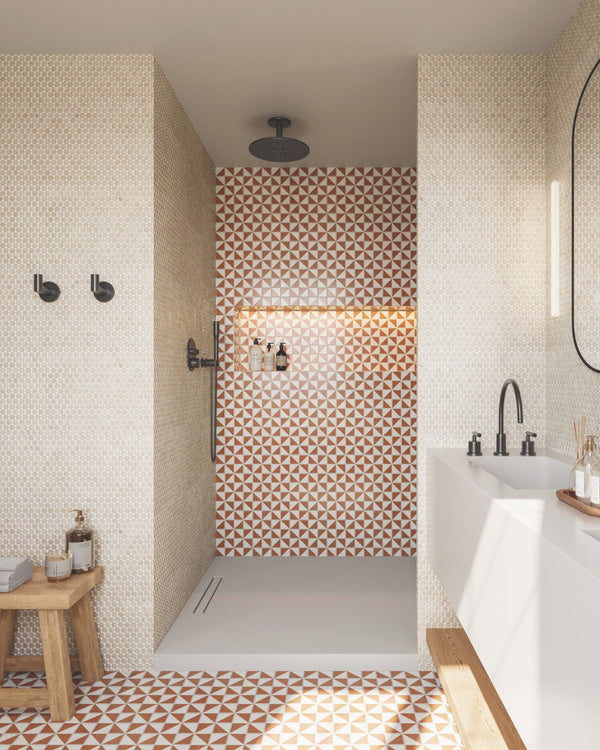
Bathroom. For a mid-century modern bathroom, pair a penny tile or small hex floor in white with contrasting grout in black, charcoal, or a period color, and tile the walls in full-field 4x4 ceramic in avocado, harvest gold, or turquoise. Keep the grout consistent on the wall and let the floor pattern do the work. A single accent wall in a bold period color against white fixtures is a lower-commitment version of the same direction. Browse the full bathroom tile collection for mid-century compatible formats and colors.
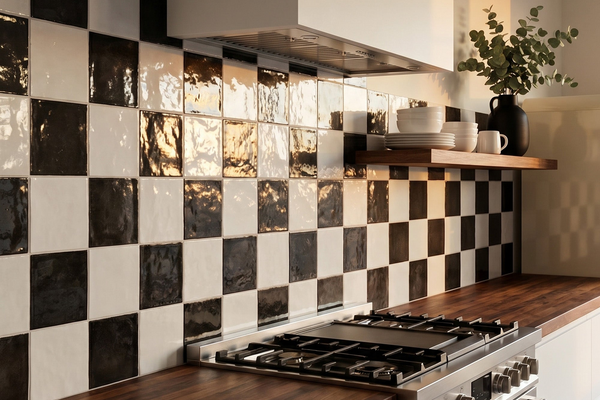
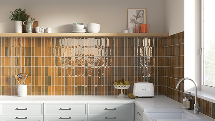
Kitchen. For a mid-century modern kitchen, tile the backsplash in a geometric mosaic or full-field ceramic in a period color from counter to cabinet. Avocado green, harvest gold, and warm coral read as authentically mid-century if you balance them against white cabinets and natural wood. A two-tone backsplash alternating a period color with white in a simple pattern is one of the most flexible looks in the style.
Fireplace. For a mid-century modern fireplace, tile the surround in a solid period color or simple geometric pattern. Gloss turquoise, warm gold, or terra cotta reads strongly as the era and transforms a plain fireplace into a focal point. Keep the surround pattern simple and let the color carry it.
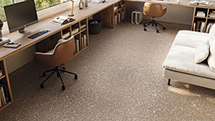
Living Areas and Entryways. For main living area floors, terrazzo-effect porcelain or a large geometric tile in a period-adjacent neutral brings mid-century character without committing to bold color throughout. Warm gray, tan, and speckled cream are all period-appropriate base tones that work with the furniture typical of the style.
How to Choose Mid-Century Modern Tile
Decide how literally you want to interpret the era. A fully authentic mid-century modern bathroom means period colors, glossy surfaces, small-format tile, and two-tone grout. A looser interpretation takes the geometry and leaves the avocado. Neither approach is wrong, but know which direction you're going before you order samples.
Grout color is as important as tile color. On geometric and small-format tile, grout is part of the pattern. A white penny tile floor with white grout reads as a soft, neutral surface. The same tile with black grout reads as a graphic, period-specific pattern. Choose your grout color before you finalize the tile.
Match the finish to the era. Original mid-century tile was almost universally glossy or satin ceramic. Matte finishes on small-format tile read as contemporary. If you want the look to feel authentic, lean toward glossy on walls and satin on floors.
Scale the pattern to the room. A dense geometric mosaic reads differently in a 40-square-foot bathroom than in a 200-square-foot kitchen. In a small room, a strong pattern covers the whole field and becomes the room. In a large room, the same pattern may need a simpler repeat to avoid visual noise at scale.
Tile Mart ships nationwide. Whether you're restoring a California ranch or bringing mid-century character to a new build, your order ships directly to your door. Browse the full collection above and order samples before committing.
-
 Concrete Tiles
 -
 Patterned & Decorative Tiles
 -
 Handmade Look Tiles
 -
 Zellige Tiles
 -
 Modern Tiles
 -
 Contemporary Tiles
 -
 Traditional Tiles
 -
 Rustic Tiles
 -
 Farmhouse Tiles
 -
 Industrial Tiles
 -
 Mediterranean Tiles
 -
 Bohemian Tiles
 -
 Coastal Tiles
 -
 Scandinavian Tiles
 -
 Eclectic Tiles
 -
 Art Deco Tiles
 -
 Minimalist Tiles
 -
 Transitional Tiles
 -
 Encaustic Tiles


