

Education

Tiling a living room wall works best with large-format tile: anything with one side of 15 inches or more, most often a 24x48 porcelain. Fewer grout lines let the pattern run across the wall without interruption, and porcelain wipes clean in a room that sees daily use. The trade-off is prep. Big tiles need a flat wall and the right mortar, so the substrate matters as much as the tile you pick.
Quick answer: For a living room feature wall, choose a 24x48 porcelain in a stone, concrete, ribbed, or wood look. Porcelain handles a living room's traffic and light better than most alternatives, and the wall needs to be flat within 1/8 inch over 10 feet before anything gets set.
Below are five directions we see working in real rooms, a size comparison to help you choose a format, and the prep questions worth asking before you order. If you are still deciding on a surface, our wall tile collection is the broader starting point.

Why large wall tiles suit a living room
A living room wall is usually the largest uninterrupted surface in the house, which is exactly where big tile pays off.
-
Fewer grout lines. One 24x48 tile covers 8 square feet. The same area in 12x12 tile means eight tiles and roughly three times the grout, so the wall reads as one surface instead of a grid. -
Pattern continuity. Marble-look and stone-look porcelain is printed with veining that runs across the face of the tile. At 24x48 the veining carries far enough to look like slab, which it cannot do at small sizes. -
Less to clean. Grout is the part of a tiled wall that holds dust and marks. Less of it means a wipe-down keeps the wall current, which matters behind a sofa or a media console. -
A calm backdrop. A low-contrast tiled wall gives art, shelving, and lighting something to sit against without competing for attention.

What type of tile is best for a living room wall?
Porcelain is the default, and for good reason. It is dense, colorfast under direct sun, and available in the large formats this look depends on. Here is how the options compare in a living room specifically.
-
Porcelain. The most practical choice. It holds color next to a bright window, comes in 24x48 and larger, and needs no sealing. Stone looks, concrete looks, and wood looks are all printed on porcelain bodies. -
Ceramic. Lighter than porcelain and easier to cut, which helps on an interior wall with outlets and switches. Ceramic is a good fit for ribbed and relief panels, where the format is usually moderate rather than oversized. -
Natural stone. Real marble, travertine, and slate bring depth that print cannot fully match. Stone is heavier, needs sealing, and shows genuine variation from piece to piece, so order enough to blend and expect the wall to look less uniform than porcelain. -
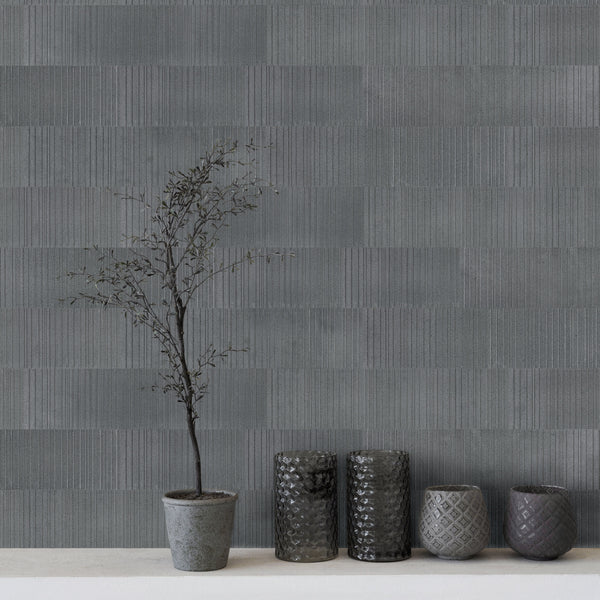
Ribbed and fluted panels. A newer category worth knowing about. These carry a sculpted relief on the face, so the wall changes through the day as light moves across it. They work well where a flat tile would read as empty.

Large wall tile sizes compared
"Large format" is a technical term, not a marketing one: it covers any tile with at least one side of 15 inches or longer. That range is wide, and the size you pick changes both the look and the install.
| Size | How it reads on a wall | Best for | Worth knowing |
|---|---|---|---|
| 12x24 | Still a visible grid, but a quiet one | Narrow walls, chimney breasts, half-wall runs | The easiest large format to handle alone |
| 24x24 | Even and architectural, no direction | Concrete and cement looks, grid layouts | Square tile makes lippage easier to spot |
| 12x48 | Long horizontal bands, or vertical stripes stacked | Widening a narrow room, or lifting a low ceiling | Long thin tiles show any bow in the wall |
| 24x48 | Closest to slab at a workable size | Marble and onyx looks behind a sofa or fireplace | The most common feature-wall size we ship |
| 48x48 and gauged panels | Near seamless, book-matched veining possible | Full-height walls where continuity is the whole point | Needs a two-person crew, specialist tooling, and suction handling |
One practical note on proportion: tall tiles or a vertical stack draw the eye up and help a low ceiling, while long horizontal runs stretch a narrow room sideways. Pick the orientation for the problem you are solving, not just the look.
5 living room wall tile ideas
1. A stone-effect feature wall
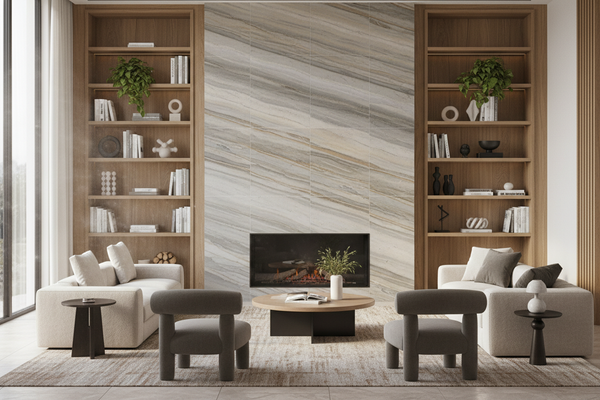
The most requested version of this look. Large-format porcelain printed with marble or onyx veining gives you the drama of a stone slab behind the sofa without the weight, the sealing, or the cost of real stone. Matte finishes suit rooms with a lot of natural light, since they soften glare rather than bounce it. Warm wood furniture and wool textiles keep a high-contrast stone wall from feeling cold.
2. Concrete looks for an urban feel
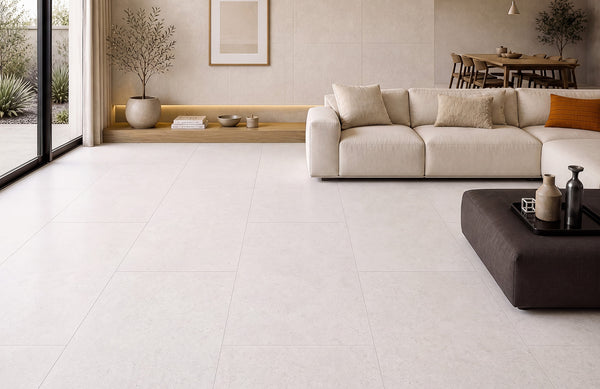
Cement-look porcelain covers a wider range than most people expect, from pale chalky whites through to deep charcoals. The lighter end is the more livable choice in a living room: it holds the industrial texture and matte surface without darkening the space. Pair it with black metal fixtures, leather, and open shelving. A honed finish gives you a very slight sheen, which stops a large pale wall from looking flat.

3. Ribbed panels for texture without pattern
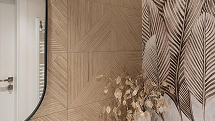
If a flat wall looks empty but a bold pattern feels like too much, a ribbed or fluted panel sits neatly between the two. The relief is cut into the face of the tile, so the wall picks up shadow lines that shift as daylight moves through the room and change again under lamps at night. Because the interest comes from the profile rather than the print, these panels work in a single quiet color and let your art and furniture stay the focus.

4. A modern take on a classic layout
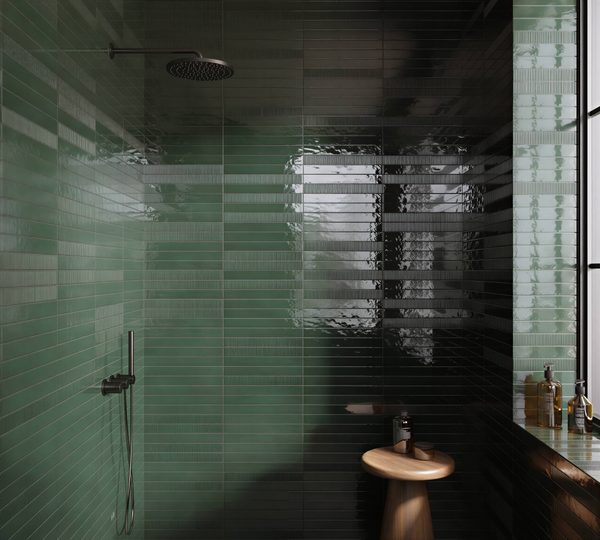
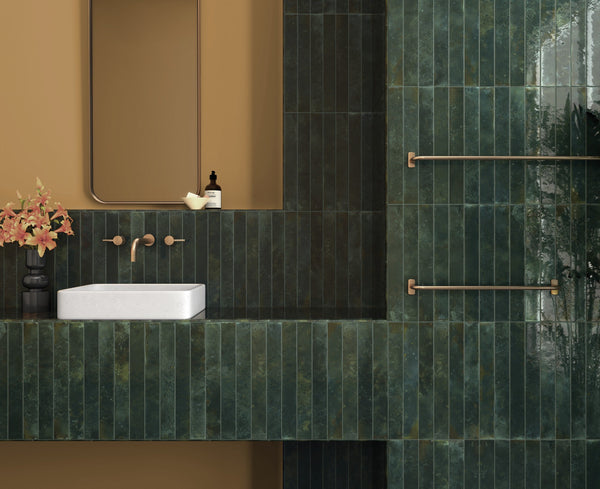
Familiar patterns change character at a bigger scale. A herringbone laid in 12x24 rather than 3x12 reads as a graphic zigzag instead of a busy weave, and it uses far fewer cuts. Oversized subway tile does something similar: the shape is recognizable, but at 4x16 or larger, in a color like sage, clay, or charcoal, it stops looking like a kitchen backsplash. Stack-bond and vertical stack layouts are worth considering too, since both suit large formats better than a running bond does.
5. Wood-look planks on the wall
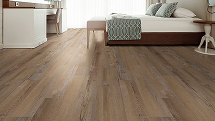
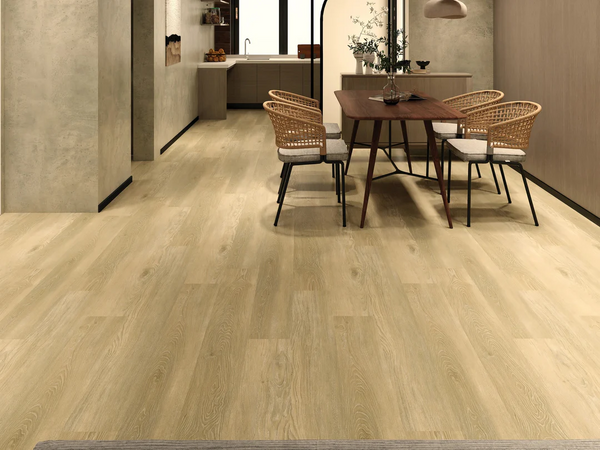
Wood-look porcelain planks are usually specified for floors, but on a wall they add the warmth a hard surface can otherwise lack. Extra-long planks, around 59 inches, run almost the full width of a chimney breast in a single piece, and can be laid horizontally, vertically, or in a chevron. You get the grain and color of timber with a surface that does not need refinishing. This is a strong option beside a fireplace, where real wood would be the wrong material.

What to sort out before you tile the wall
Large-format tile is less forgiving than small tile, and almost every problem traces back to the wall behind it rather than the tile itself. Be straight with your installer about these four things before you order.
-
The wall has to be flat. Industry standards for tile with any side of 15 inches or more call for a substrate flat to within 1/8 inch over 10 feet, and 1/16 inch over 2 feet. On a bowed or wavy wall, that means skim coating or re-boarding first. Skipping this step is the single most common cause of a disappointing result. -
Lippage is the thing to watch. Lippage is the small height difference where one tile edge sits proud of its neighbor. It is far more visible on a big tile catching side light than on a small one. Leveling clips help, and so does planning for a grout joint of at least 1/8 inch rather than trying to butt the tiles tight. -
The mortar is not the standard bag. Large and heavy tile mortar, sometimes still called medium bed, is formulated to support the weight of a big tile on a vertical surface without slumping while it cures. Regular thin-set is the wrong product here. -
Weight and support. Large-format porcelain adds up quickly on a wall. Interior drywall in sound condition will take a tiled wall, but the boards need to be securely fixed and properly prepared, and heavier assemblies are better on a cement backer board. Confirm the build-up with whoever is installing.
Honest assessment: a 24x48 feature wall is not a beginner project. Two people are needed to place each tile, and 48x48 or gauged panels need specialist suction handling and cutting equipment. If you are hiring, ask specifically whether the installer has done large format on a vertical surface.

Design tips for a wall that fits the room
-
Work with your floor, not against it. If the flooring already has strong pattern or movement, keep the wall quieter. If the floor is plain, the wall can carry the interest. -
Match the finish to your light. Polished surfaces reflect light and lift a darker room, but they also show every fingerprint and reflect glare from a window. Matte and honed finishes absorb light and hide marks, which is usually the safer bet on a wall in daily use. -
Decide where the wall stops. Running tile to the ceiling reads as architecture; stopping at picture-rail height or partway up reads as paneling. Both work, but tiling only a half wall behind a sofa is a smaller job and often the more balanced choice in a room with tall walls. -
Plan the edges early. Outside corners and the top edge need either a mitred cut or a matching trim. Sorting this before you order avoids a compromise at the end. -
Check the tile in your own room. Our product photos are the fastest way to judge overall look, layout, and scale, and a sample settles the rest. Order through our sample program, then hold the tile flat against the wall in daylight and again at night under your own bulbs, run your hand over the surface to feel the finish, and set it beside your flooring, paint, and any wood or metal it will sit next to. For stone looks and real stone, order more than one piece so you can see how the veining and shade movement varies from tile to tile. Our 365-day return window means you are not locked in if the room changes your mind later, and shipping is a flat rate nationwide.
Frequently asked questions
What type of tile is best for a living room wall?
Large-format porcelain, most commonly 24x48. It is dense, holds its color next to a window, needs no sealing, and comes in the stone, concrete, and wood looks that suit a living room. Ceramic is a good alternative for ribbed and relief panels, and natural stone is worth the extra prep if you want genuine depth and variation.
Can large tiles be used on walls?
Yes. Sizes up to 24x48 are standard on interior walls, and gauged porcelain panels go considerably larger. The requirements are a flat, sound substrate, a large and heavy tile mortar rated for vertical use, and an installer who has worked at that size before.
Do large wall tiles make a room look bigger?
They make a wall look less busy, which reads as more open. Fewer grout lines mean fewer visual breaks, so the surface is perceived as one plane rather than a grid. The room's dimensions do not change, and a light matte finish will do more for a sense of space than tile size alone.
Are 12x24 tiles outdated?
No. 12x24 is still the most widely used large-format size and it remains a sensible pick for narrower walls and half-wall runs. What has changed is that 24x48 has taken over as the default for full feature walls, so 12x24 now reads as understated rather than dated.
Can you tile a living room wall over drywall?
In a dry interior room, yes, provided the drywall is sound, securely fixed, flat to tolerance, and primed as the mortar manufacturer specifies. Heavier large-format assemblies are more reliably installed over cement backer board. Confirm the build-up with your installer before ordering.
How do I choose between a matte and a polished finish?
Match it to the light. Polished reflects and brightens, which helps a north-facing or windowless room, but it shows marks and can throw glare. Matte and honed finishes stay even through the day and hide fingerprints, making them the more forgiving option on a wall you will live with.
The tile is the easy part of this decision. Get the wall flat, choose a finish that suits your light, and pick a size that solves your room's proportions, and almost any of these five looks will work. When you are ready to compare options side by side, our large format tile collection is where to start.