

Education

Summary Box: While sealing travertine, limestone, and slate is essential for long-term maintenance, each natural stone requires protection for different reasons and on its own schedule. Travertine needs penetrating sealers to protect gas cavities and factory fill; soft limestone requires deep-soaking sealers to reduce moisture and dirt absorption; and slate requires sealing primarily to manage surface cleft texture and prevent rust. Because sealers prevent staining but cannot stop acid etching, perform a simple 5-minute water test on your floor or sample swatch to determine exactly when it is time to reseal.
Most articles on this question treat natural stone as a single material with a single answer. That's how people end up disappointed six months in, when a floor behaves nothing like the guide said it would.
Sealing travertine, limestone, and slate is worth doing for all three, but the reason differs for each, and so does the schedule. Travertine's issue is its voids. Limestone's softness. Slate's has almost nothing to do with absorption. Marble follows its own rules, and we cover those in our marble sealing guide.

Travertine vs. Limestone vs. Slate Maintenance At a Glance
| Natural Stone | Primary Reason for Sealing | Sealer Type Typically Used | Resealing Frequency | Signs Sealer Is Failing |
|---|---|---|---|---|
| Travertine | Fills gas cavities; protects exposed voids | Penetrating / Impregnating | 1–3 Years | Water absorbs into fill; surface darkens |
| Limestone | High softness; porous, variable absorption | Penetrating (Deep-Soaking) | 1–2 Years (High Traffic) | Moisture absorption; rapid dirt buildup in wear tracks |
| Slate | Cleft texture traps dirt; prevents rust/flaking | Penetrating or Enhancing | 3–5 Years | Surface flakes easily; dirt embeds in ridges |
What Sealing Travertine, Limestone, and Slate Cannot Do?
A sealer buys you time to wipe up a spill. It does not make stone stain-proof, and on travertine and limestone, it does nothing at all to prevent etching.
Etching is chemical damage, not staining. Both stones are calcareous, meaning calcium-based, so anything acidic will dissolve the surface on contact and leave a dull mark. Lemon juice, wine, vinegar, tomato, and most bathroom cleaners all do it. A sealed floor etches the same as an unsealed one. This is the most common misunderstanding about stone sealers, and knowing it up front changes how you use the room.
The three sealer categories work differently. Penetrating or impregnating sealers soak in and slowly absorb from within, leaving the look unchanged. Topical sealers form a film on the surface and wear in traffic paths. Enhancing sealers deepens color and saturation. Follow the manufacturer's instructions on whichever you choose, since dwell times and coat counts vary by product.
Does Travertine Need to Be Sealed?
Yes, and the filled voids are the real story.
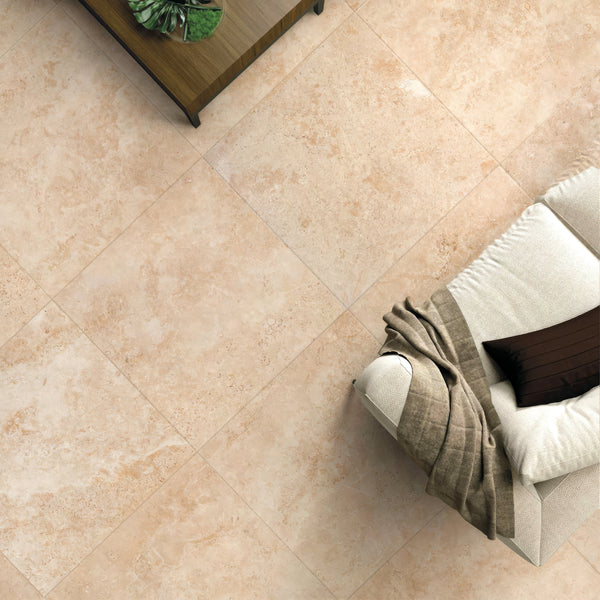
Travertine forms with gas-bubble cavities running through the stone. Filled and honed travertine has those cavities filled and ground flat, which is what most people picture. Tumbled and unfilled travertine leaves them open on purpose, as part of the look, and our travertine tile collection carries both, so you can see the two side by side.
Fill material is not the same density as the surrounding stone, and over the years of traffic and cleaning, some fill material loosens or pops out. That is normal behavior for the material rather than a defect, and it is the most common complaint we hear about travertine. Sealing slows the accumulation of dirt and moisture in exposed cavities, but you should expect to refill the floor occasionally. Our Ivory Premium collection clearly shows the difference between filled and unfilled finishes, which is worth seeing before you commit.
Does Limestone Need Sealing?
Yes, limestone requires consistent sealing and more attentive care than travertine or slate.
Limestone is generally softer and more absorbent, but the range is wide. Under ASTM C568 (the standard specification for limestone dimension stone), physical properties range across low, medium, and high-density classifications. Always request specific quarry test data and follow Natural Stone Institute (NSI) guidance when selecting a sealer.
What softness looks like in daily use is wear patterns before stains. Traffic lanes dull first. Fine scratches accumulate and catch dirt, which reads as discoloration even when nothing has soaked in. Kitchens and entries put the hardest wear on a limestone floor. Sealing helps with absorption. It does not add hardness, so the finish you pick does more for a limestone floor than any sealer will. Our limestone tile collection lists the finish and density class for each option, which you can check against the room you have in mind.

Do Slate Tiles Need to Be Sealed?
Yes, slate requires sealing, though it remains the lowest-maintenance option among the three.
Slate is denser and significantly less absorbent than travertine or limestone, leading many homeowners to skip sealing entirely. However, slate requires sealing for texture management rather than moisture control:
- Natural Cleft Texture: Natural cleft slate features uneven ridges and micro-depressions. Unsealed cleft surfaces trap fine dirt and soap residue, making routine cleaning difficult. A penetrating sealer coats these micro-textures so debris wipes away easily.
- Flaking & Rusting: Some natural slate varieties shed thin surface layers (cleaving) or contain natural iron deposits that oxidize into rust spots when exposed to water. A penetrating sealer minimizes moisture contact with iron deposits and stabilizes loose surface layers.
Browse our durable slate tile options.
The Water Test Tells You When to Reseal Natural Stone
Calendar intervals are guesses. Your floor is evidence. Run this test on an inconspicuous area, or on a sample before you buy.
How to Perform the Water Test:
- Clean the Test Area: Clean an inconspicuous tile (or a loose swatch) with a pH-neutral stone cleaner. Allow it to dry fully. Refer to our guide on how to clean marble and natural stone tiles for approved cleaning practices.
- Apply Water Drops: Place several drops of water (roughly the size of a quarter) onto the stone surface.
- Wait 5 Minutes: Leave the water undisturbed for five minutes.
-
Inspect the Surface:
Pass: Water beading cleanly on top indicates the sealer remains active.
Fail: A dark spot beneath the water indicates that the stone is absorbing water and requires resealing. (The dark spot will disappear as the moisture dries). - Test High-Traffic Zones: Repeat this test in high-use areas near sinks, entry doors, and cooking zones, as sealers wear out faster in traffic paths than along room borders.
Repeat this in the areas that get the most use, since a floor rarely wears evenly. Sinks, entries, and the path between the door and the kitchen give out long before the corners do.
Why Sealing a Dirty Floor Is Worse Than Not Sealing
A penetrating sealer needs open, clean, dry pores to work. Apply it over dirt, soap film, an old topical coating, or a still-damp floor, and it locks all of that beneath the surface. The result is hazing, uneven cure, and contamination you can no longer reach.
Correcting it means stripping, which is expensive and can damage soft stone. Clean with a pH-neutral cleaner, never anything acidic, and allow a full dry before you seal.
The sequence matters at installation, too. On porous stone, sealing before grouting keeps grout pigment out of the pores, then a second application goes on after the grout cures.
How Often to Reseal Travertine, Limestone, and Slate
Wet areas and high-traffic floors need attention soonest. Showers, entries, and kitchen floors are sealed faster than walls and backsplashes, which can go years without being sealed. Limestone typically asks for resealing more often than travertine, and travertine more often than slate.
Beyond that ranking, the sealer manufacturer's instructions govern the interval, and the water test tells you when the interval has run out. Skip the universal number you'll see elsewhere, because it can't account for your stone, finish, or household.
When Natural Stone Isn't the Right Call
If no one in the house runs a water test or reseals the floor, the stone will eventually disappoint you. A stone-look porcelain gives you the appearance of no sealing at all, and our natural stone versus porcelain comparison walks through the trade-off honestly.
That said, plenty of people find the maintenance minor once they know what it is. The problem is discovering it afterward.

Frequently Asked Questions About Sealing Natural Stone
Does sealing travertine, limestone, or slate make the stone waterproof?
No. It slows absorption and gives you time to clean up a spill.
Will a sealer prevent etch marks?
No. Etching is acid dissolving the surface, and no sealer stops it on travertine or limestone.
Can I use the same product when sealing travertine, limestone, and slate?
Sealer categories overlap, but suitability depends on the specific stone and finish. Check the product's instructions and ask before you buy.
Does travertine need to be sealed again if the factory fill comes out?
Refill it. Fill loss is expected behavior on a travertine floor, not a product failure.
Test Your Stone Before You Commit
Run the water test on the floor you have, and you'll know where you stand in five minutes. If you're still choosing, order samples and run the same test on the swatch, so you learn how the stone absorbs before a pallet arrives.
For a sealer recommendation on your specific stone and application, contact a Tile Mart expert with both details. Browse the full natural stone collection while you're deciding.